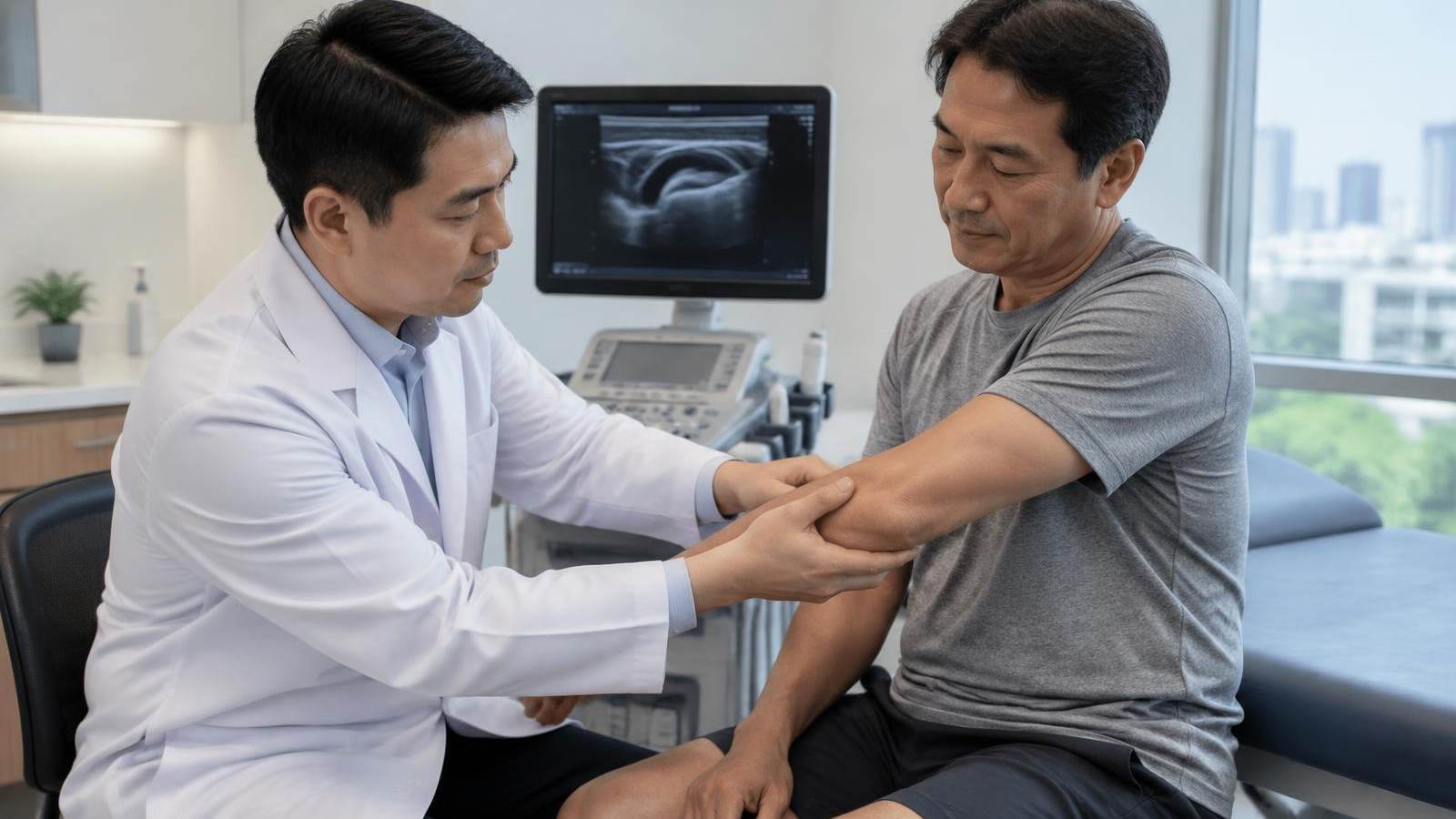
Back pain is the single most common reason people enquire about regenerative treatment, and also the area where expectations most often outrun the evidence. The spine is not a knee. This article sets out how a Bangkok clinic actually assesses a painful lower back, which findings make a regenerative approach reasonable, which rule it out, and what a realistic result looks like.
Why Chronic Low Back Pain Persists
An intervertebral disc has almost no blood supply. Nutrients reach the nucleus by diffusion through the vertebral endplates, which is why disc tissue repairs slowly and why degeneration, once established, tends to progress rather than resolve. As disc height falls, load shifts to the facet joints behind the disc, and those joints develop their own arthritic changes. Muscle guarding follows, movement patterns change, and pain becomes self-sustaining.
That biology explains both the appeal of a regenerative approach and its limits. A cell-based treatment targets the inflammatory and signalling environment inside a degenerating segment. It does not restore lost disc height, reverse bony change or undo years of altered loading, which is why rehabilitation stays part of every plan.
Stem Cell Therapy for Back Pain: What Treatment Involves in Bangkok
At MRC Healthcare, mesenchymal stem cell treatment for the spine is delivered in one of three ways, chosen after imaging review rather than by patient preference.
| Delivery route | Typical indication | Practical notes |
|---|---|---|
| Intradiscal, image guided | Discogenic pain with matching MRI findings | Sterile procedure room, imaging guidance, observation afterwards |
| Facet and paraspinal | Facet-dominant degeneration and local soft tissue pain | Shorter procedure, local anaesthetic, same day discharge |
| Intravenous | Multi-level degeneration or systemic inflammatory background | Used as an adjunct, not as a targeted spinal treatment |
Cells used are umbilical cord derived mesenchymal stem cells prepared in a controlled laboratory, with release testing for viability, identity and sterility. The background on cell sources is covered in our comparison of cord-derived and autologous cells, so it is not repeated here.
Who Is Assessed and Who Is Declined
A credible spinal assessment produces refusals as well as plans. Patients most often considered suitable have:
- Pain lasting more than six months that has not settled with conservative care
- Imaging findings that correspond to the location and behaviour of the pain
- Mild to moderate degeneration rather than a collapsed, end-stage segment
- No neurological deficit and a stable spine on examination
Treatment is declined where there is suspected infection, malignancy, fracture, cauda equina syndrome, progressive weakness, significant instability or an untreated inflammatory arthritis. In those cases the honest answer is a referral, not an injection.
What the Spinal Evidence Currently Shows
Published work on intradiscal mesenchymal cell injection consists mainly of small trials and prospective series. Several report meaningful reductions in pain and disability scores maintained over one to two years in carefully selected patients with mild to moderate degeneration. Results in advanced degeneration are consistently poorer, and radiological change is inconsistent even where symptoms improve.
The reasonable summary is that this is a supported but still developing option for a specific patient profile, not an established standard of spinal care. Any clinic promising a guaranteed outcome for a degenerative spine is overstating what the literature contains.
The Bangkok Treatment Pathway Step by Step
- Remote review. You send your MRI report and images, pain history and current medication. A physician decides whether an in-person assessment is worthwhile before you book a flight.
- Clinic assessment. Examination, blood work and, where the existing imaging is old or incomplete, repeat imaging in Bangkok.
- Procedure day. The chosen route is performed under sterile conditions with monitoring, followed by an observation period in the clinic.
- Early recovery. Relative rest for a short defined period, then a graded return to walking and loading rather than prolonged bed rest.
- Review and documentation. A follow-up appointment before departure and a written summary for your doctor at home, including what was given and how to monitor progress.
Recovery sensations after any cell-based procedure follow a familiar pattern, set out in our article on how long stem cell side effects last.
Planning a Trip to Thailand for Spinal Care
Bangkok is a practical base for this kind of treatment because assessment, imaging, laboratory work and the procedure itself can be arranged in one week rather than across months of separate appointments. Our facility sits within the city's private healthcare district, with English-speaking coordination for visitors from Australia, Singapore and Europe.
Bring your imaging on disc or in digital form, a written medication list and any previous injection or surgical records. Practical trip planning is covered in our medical travel checklist for Thailand, and the wider treatment context in our degenerative spine service page.
Have Your Spinal Imaging Reviewed First
Send your MRI report and history for a physician review before making any travel plans. If a regenerative approach is not appropriate for your spine, we will say so.
Schedule a Consultation