Cardiovascular Therapy
EECP — Enhanced External Counterpulsation
A non-invasive, ECG-timed therapy that uses sequential leg cuff inflation to support coronary blood flow and circulation — an established option for patients with refractory angina who are not candidates for further intervention.
- Session length
- About 1 hour
- Standard course
- 35 sessions
- Anaesthesia
- None required
- Recovery
- No downtime
What is enhanced external counterpulsation?
EECP uses pneumatic cuffs wrapped around the calves, lower thighs and upper thighs. Timed to your ECG, the cuffs inflate sequentially from the calves upward during diastole — the phase when the heart relaxes and the coronary arteries fill — then deflate rapidly just before the next heartbeat.
This pattern increases blood return to the heart during diastole and reduces the resistance the heart works against during the next contraction. In clinical use it is applied to refractory angina: chest pain that persists despite optimal medication and where bypass surgery or stenting is not an option.
At MRC Healthcare, EECP is only started after cardiology review. It complements — and never replaces — prescribed cardiac medication and specialist care.

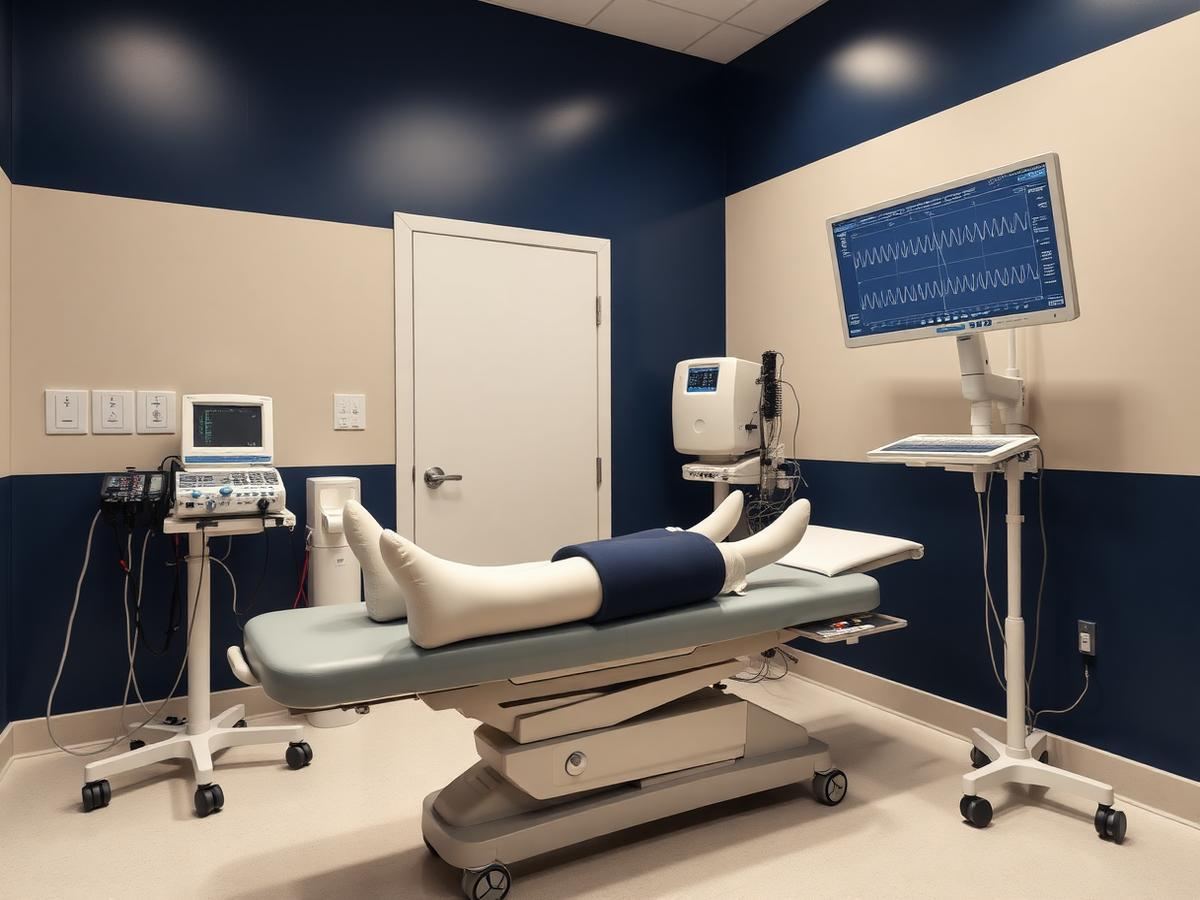
Inside the EECP treatment room
Each treatment bay is set up with a counterpulsation unit, a continuous ECG display and a finger plethysmograph so the inflation cycle can be timed precisely to your own heart rhythm. A clinician stays with you and adjusts cuff pressure to a level you tolerate comfortably.
Because timing is everything in counterpulsation, the waveform is monitored throughout the hour. If your rhythm changes, the machine re-syncs or the session is paused and reviewed with the supervising physician.
ECG-gated inflation and deflation, adjusted session by session
Cuff pressure titrated gradually over the first sessions for comfort
Symptom and angina-frequency review at regular intervals during the course
Care coordinated with your own cardiologist and existing medication plan
EECP is delivered in a monitored treatment bay with continuous ECG timing.
What the therapy targets
Diastolic augmentation
Cuff inflation timed to diastole supports blood flow during the heart's filling phase.
Reduced cardiac workload
Rapid deflation before systole lowers the resistance the heart pumps against.
Structured course
Delivered as a standard course of repeated sessions rather than one-off treatment.
Non-invasive
No incisions, catheters or anaesthesia — you remain awake and clothed throughout.
Who it may suit
Patients with chronic stable or refractory angina despite optimal medical therapy
Patients who are not suitable candidates for angioplasty, stenting or bypass surgery
Patients with reduced exercise tolerance from ischaemic heart disease, under cardiology supervision
Patients seeking a non-invasive adjunct alongside their existing cardiac care plan
What a session involves
Cardiology assessment
Your cardiac history, medication, ECG and any prior imaging are reviewed to confirm EECP is appropriate and safe.
Set-up
You lie on a treatment bed. Cuffs are fitted to the calves and thighs, and ECG leads plus a finger sensor are attached to time the cycle.
Treatment
Sessions last about one hour. You feel a firm, rhythmic squeezing that travels up the legs with each heartbeat; most patients read or rest.
Course and review
A standard course is typically 35 one-hour sessions, usually five days a week over about seven weeks, with symptom review throughout.
Preparing for your course
Before you start
Bring your current medication list, recent ECG, echocardiogram and any angiography reports. Cardiology clearance is arranged before the first session.
On treatment days
Eat a light meal, avoid a heavy meal in the hour beforehand, empty your bladder before starting and wear or bring close-fitting leggings or cycling shorts under the cuffs.
Between sessions
Continue all prescribed cardiac medication, keep a simple note of angina episodes and walking tolerance, and report any new leg soreness or skin marking.
Important considerations
EECP requires cardiology clearance and is not started without it.
It is not suitable in decompensated heart failure, severe aortic regurgitation, aortic aneurysm, uncontrolled arrhythmia or severe uncontrolled hypertension.
It is avoided in active deep vein thrombosis, significant peripheral arterial disease, bleeding disorders or when on high-intensity anticoagulation without review.
Common effects are mild leg or skin soreness and fatigue; padded clothing under the cuffs reduces this.
EECP is an adjunct to — not a substitute for — prescribed cardiac medication and specialist follow-up.
Clinical context for international patients
- EECP is recognised internationally as a non-invasive option for chronic refractory angina in patients who remain symptomatic despite optimal medical therapy and are unsuitable for further revascularisation.
- It is a course-based therapy: benefit is assessed across the full programme of sessions rather than after a single treatment, so travel plans should allow for a continuous schedule.
- Patients travelling from Australia, Singapore, the UK and Europe are asked to send cardiology records ahead of arrival so suitability can be confirmed before booking flights.
- EECP does not treat the underlying coronary disease; risk-factor management, medication and specialist follow-up continue alongside it.
Frequently asked questions
Related care at MRC Healthcare
Book Your Session
Our medical team can review your history and advise whether this is appropriate for you. International patients are welcome.
MRC Healthcare
Reviewed by MRC Healthcare Medical Team
Last updated: