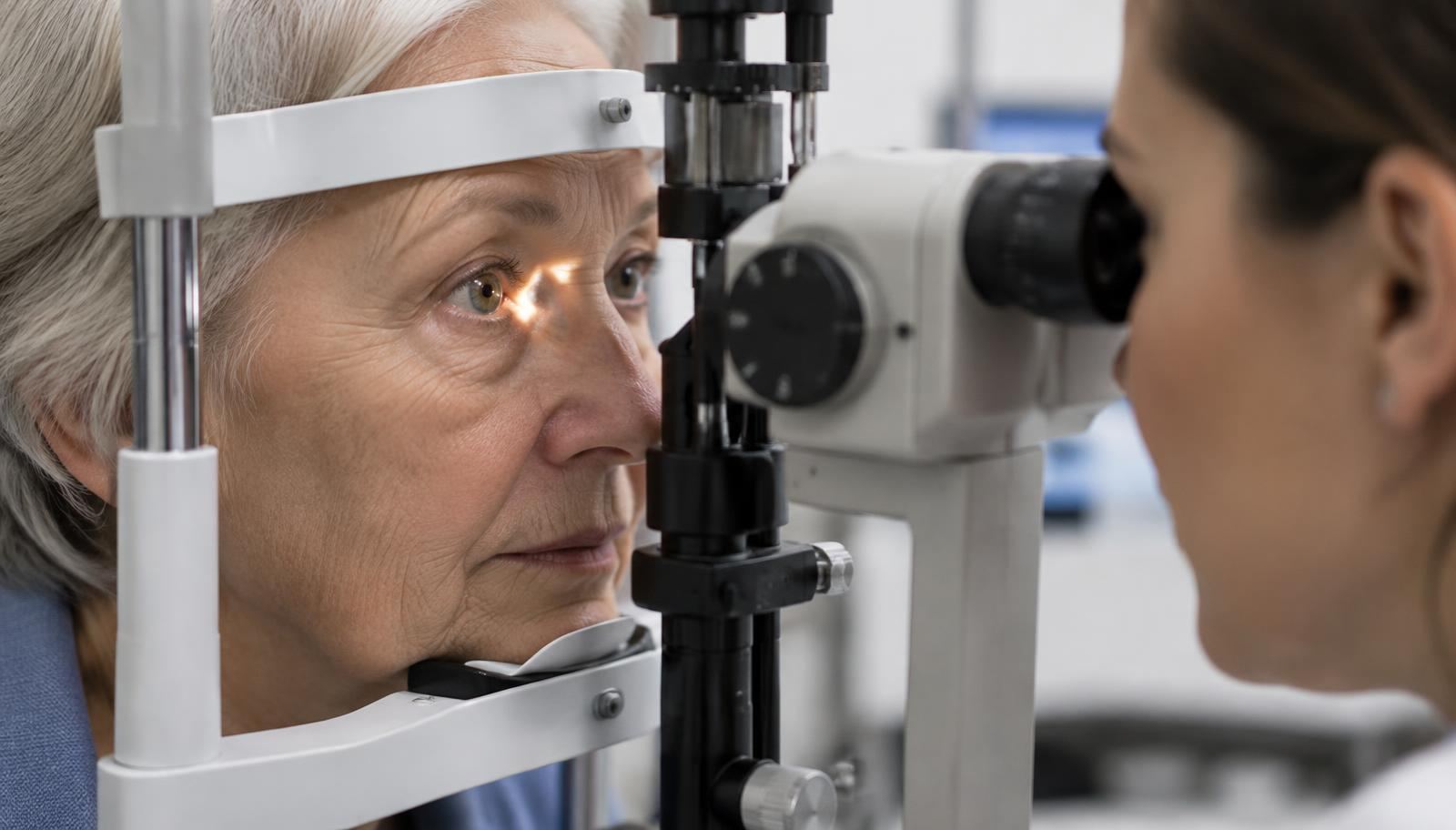
When the Centre of Your Vision Starts to Blur
It often shows up first as something small. Straight lines look slightly bent. Faces are harder to recognise across a room. Reading needs more light than it used to, then more magnification, then more effort than it feels worth.
For many people, the hardest part of macular degeneration is being told that nothing more can be done, especially with the dry form. That sentence is usually what sends people searching for stem cell therapy for macular degeneration.
This guide explains what the condition is, what standard care genuinely achieves, and where retinal cell research realistically stands, including its limits.
What Macular Degeneration Actually Is
Age-related macular degeneration, or AMD, damages the macula, the small central part of the retina responsible for sharp, detailed vision. Side vision usually stays intact, which is why AMD does not cause complete blindness, but it takes away exactly the vision you use to read, drive and recognise faces.
It comes in two forms:
- •Dry AMD: the common, slower form, where retinal support cells gradually break down
- •Wet AMD: the faster form, where abnormal blood vessels leak fluid or blood under the retina
- •Geographic atrophy: the advanced stage of dry AMD, with patches of retinal cell loss
The distinction matters because treatment options differ completely between the forms, and so does the research.
What Standard Care Achieves
For wet AMD, anti-VEGF injections are one of the genuine success stories of modern eye medicine. Started promptly and maintained, they stabilise vision in most patients and improve it in some. If you have wet AMD and are not under the care of a retinal specialist, that is the first step, before anything else.
For dry AMD, options are more limited. A specific high-dose vitamin formulation known as AREDS2 can slow progression in people at certain stages. Newer injections for geographic atrophy have become available in some countries, with modest effects and their own risks. Low-vision rehabilitation, often overlooked, helps people use their remaining sight far better.
The honest gap is dry AMD, especially its advanced form. That is where retinal cell research concentrates, and where realistic hope and unrealistic promises need to be separated carefully.
Stem Cell Therapy for Macular Degeneration: Where the Evidence Stands
The retina is one of the most serious targets in regenerative medicine. Researchers have grown retinal pigment epithelial cells from stem cells in the laboratory and transplanted them into patients in early clinical trials. In some studies the transplanted cells survived and remained in place, an important proof of concept.
The honest position: stem cell therapy for macular degeneration is investigational. Surviving transplanted cells are not the same as restored vision, and no cell therapy is proven to restore useful sight in AMD. Anyone offering guaranteed vision recovery should be treated with extreme caution; unproven eye injections have caused serious harm in documented cases.
For broader context on how these therapies are developed and assessed, see the types of stem cells explained and how to think about stem cell safety.
Comparing Your Options
| Approach | What it does | Role in AMD care |
|---|---|---|
| Anti-VEGF injections (wet AMD) | Stops leaking vessels, stabilises vision | Standard of care, proven |
| AREDS2 vitamins (dry AMD) | Slows progression at certain stages | Evidence-based, modest effect |
| Low-vision rehabilitation | Maximises remaining sight and independence | Undervalued, helps at every stage |
| Stem cell-derived retinal cells | May support or replace damaged retinal cells | Investigational, early trials only |
Assessment in Thailand at MRC Healthcare
At MRC Healthcare, an eye-related enquiry begins with a review of your ophthalmology records: OCT scans, the form and stage of AMD, and what treatment you have already received. Where standard specialist care is the right answer, we say so and help you understand why.
Where supportive options are discussed, the conversation is honest about what is proven and what is investigational, and any plan is built around measurable goals reviewed at a defined point.
For Patients Travelling from Abroad
Patients contact our Bangkok facility from Australia, Singapore, Europe and beyond. Records and imaging can be reviewed in advance and a first consultation can often begin remotely, so you know whether a trip is worthwhile before booking it.
English-speaking coordination is available throughout, including help planning the length of stay around any assessment schedule.
Medical References
- NHS. Age-related macular degeneration: symptoms and treatment
- International Society for Stem Cell Research. Guidelines for Stem Cell Research and Clinical Translation
Get an Honest Answer About Your Vision
Send your eye reports and scans to MRC Healthcare. Our medical team will tell you plainly what is proven, what is investigational, and whether any option may have a place in your care.
Schedule a Consultation