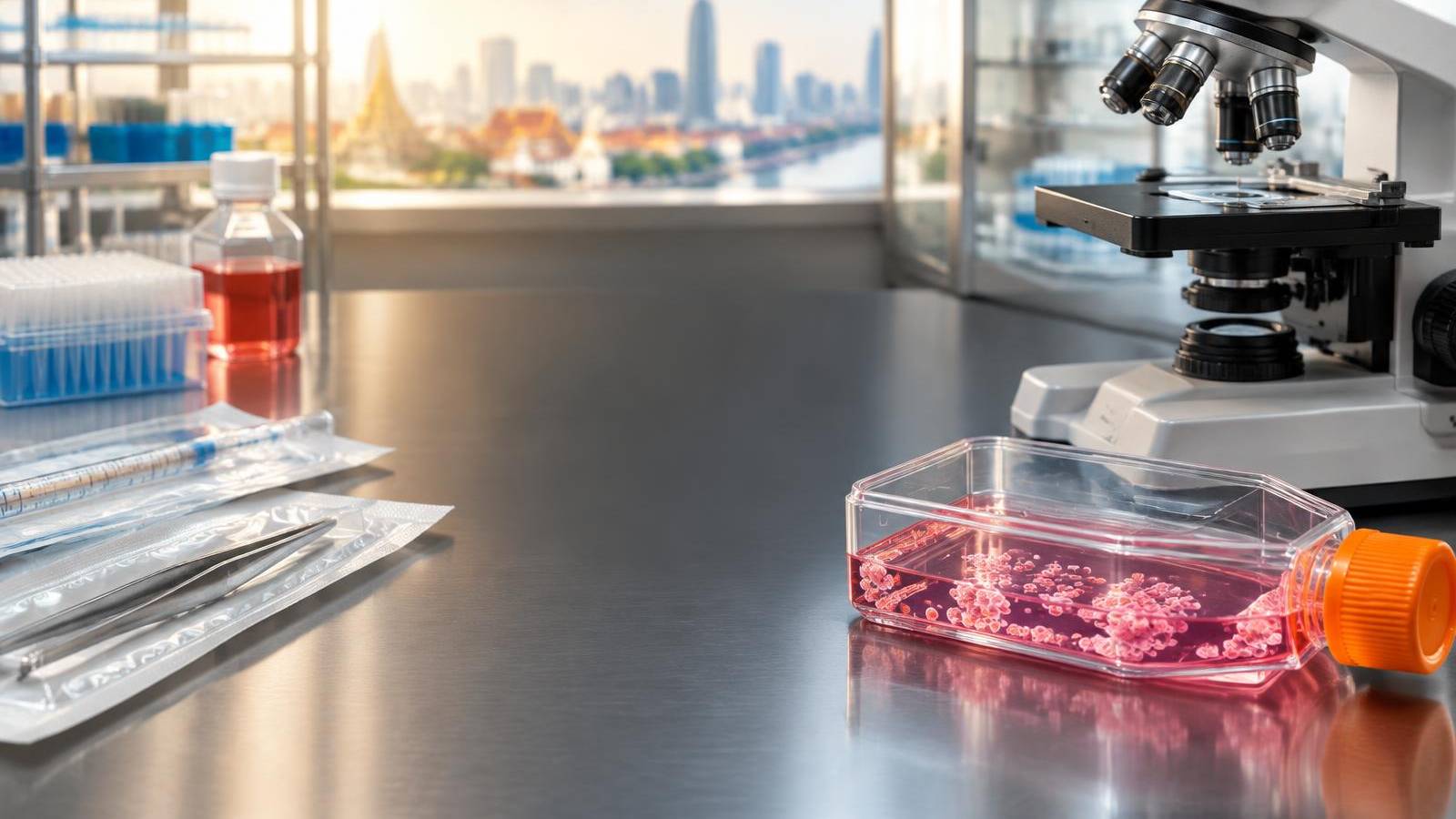
From internationally accredited hospitals to a new national framework for advanced cell therapies, Bangkok has quietly become one of Asia's most capable destinations for regenerative medicine — and one of its most comfortable.
A City Built for Modern Healthcare
Bangkok's reputation as a healthcare destination did not appear overnight. Over the past three decades the city has grown a dense network of specialist hospitals, diagnostic centres and licensed clinics, supported by a hospitality culture that Thailand has refined for far longer than that.
The practical details are what visitors notice first:
- Internationally trained physicians — teams in Bangkok's international facilities commonly hold training or fellowships abroad and consult in English
- Language support — interpreters available in Arabic, Mandarin, Japanese and other languages
- International patient departments — records transfer, appointment sequencing, insurance correspondence and airport pickups handled for you
- Connectivity — two international airports, excellent long-haul links, and a few hours' flight from much of Asia
That combination is why patients arrive from across Asia, the Middle East, Australia and Europe, and why Bangkok offers a depth of medical choice few cities can match at comparable convenience.
World-Class Hospital Infrastructure
The clearest external measure of Thailand's clinical infrastructure is international accreditation. As of late 2025, Thailand has around 65 JCI-accredited hospitals and medical facilities, more than any other country in Southeast Asia and among the highest counts worldwide.
| JCI accreditation | What it covers |
|---|---|
| Who runs it | Joint Commission International — a voluntary review against standards used in the United States and adopted globally |
| What assessors examine | Infection prevention, medication management, surgical safety protocols, staff credentialing and emergency preparedness |
| How outcomes are handled | Clinical outcomes must be recorded and demonstrably acted upon |
| How often | Facilities are re-surveyed on a cycle, so accreditation reflects sustained practice rather than a single inspection |
For an international patient that matters concretely: the safety systems around your care have been measured against the same benchmarks used at home. Around that accredited core sits laboratory infrastructure, imaging capability and specialist referral networks — the supporting resources that make advanced regenerative programmes practical to run well.
A New National Framework for Regenerative Medicine
Thailand has also moved to formalise how cell-based medicine is governed. In May 2024 the government issued a ministerial decree classifying stem cell and cell-based treatments as Advanced Therapy Medicinal Products (ATMPs) under the Drug Act — placing them in a defined regulatory category rather than a grey zone. Under that framework:
- Cell products must be prepared under Good Manufacturing Practice conditions
- Products must be registered with the Thai FDA
- Sourcing, processing and release testing must be documented
- Traceability runs from donor material through to administration
- The approach deliberately mirrors the European Medicines Agency model for advanced therapies
For patients this is a welcome development. It gives you documentation you can request and read — what the product is, where the material originated, how it was manufactured and how each batch was tested — and it lets you compare providers on substance rather than presentation.
What International Patients Can Expect
The journey usually begins long before the flight. A typical sequence looks like this:
- Records review — history and recent imaging shared for medical assessment
- Video consultation — confirms whether treatment is appropriate before anything is booked
- Scheduling — a plan drafted around your travel dates
- Entry — a dedicated medical treatment visa for longer programmes; many nationalities enter visa-free for shorter stays
- On the ground — serviced apartments and hotels minutes from the facility, interpreter support as standard, and transport between accommodation and appointments typically arranged
- Aftercare — written notes prepared so your doctor at home can pick up follow-up seamlessly
Clinics such as MRC Healthcare combine physician-led assessment with in-house laboratory capability, so cell preparation, quality control and clinical delivery stay under one accountable roof. If you would like your case reviewed before planning travel, you can arrange a consultation and begin with a records review.
Combining Treatment With Recovery
One of Bangkok's quieter advantages is how pleasant it is to rest here. Treatment programmes often include days between sessions, and the city is unusually well equipped to make those days restorative rather than idle:
- Five-star hotels with full wellness floors, riverside retreats and quiet garden courtyards within easy reach of the medical districts
- Long-standing Thai spa traditions for genuinely restful downtime
- Gentle activity — Lumphini Park in the early morning, temples and river ferries of the old city, art galleries
- A food culture ranging from street stalls to internationally recognised restaurants, with dietary requirements easily accommodated
- Plenty for travelling companions, which makes a longer stay comfortable for families
Rest is not an afterthought in regenerative care — recovery time supports how you feel through a course of treatment, and Bangkok makes that part of the trip genuinely enjoyable.
Choosing the Right Clinic in Bangkok
With a wide choice available, a short checklist helps you shortlist confidently. Look for:
- ISO-certified laboratory facilities and GMP-standard cell processing
- A physician-led team where a licensed doctor assesses candidacy and signs off the plan
- A clear written quote setting out what is included before you commit
- A stated method for how your case will be assessed and progress reviewed
- Defined follow-up once you return home
Clinics that answer these questions readily tend to be the ones documenting their work properly. Our guide to the questions to ask before choosing a clinic sets these out in a form you can take to any provider.
From there, matching the treatment to your diagnosis is the substantive step. You can review the regenerative treatments we offer for an overview of what is available on site, and read about cellular therapy options to understand how mesenchymal stem cell protocols are prepared and delivered. Outcomes vary between individuals, and a good clinic will explain realistic expectations for your specific case.
Planning a Trip to Bangkok for Treatment?
Share your diagnosis and recent records and our medical team will review your case, explain what is appropriate and help you plan the timing around your travel.
Schedule a Consultation