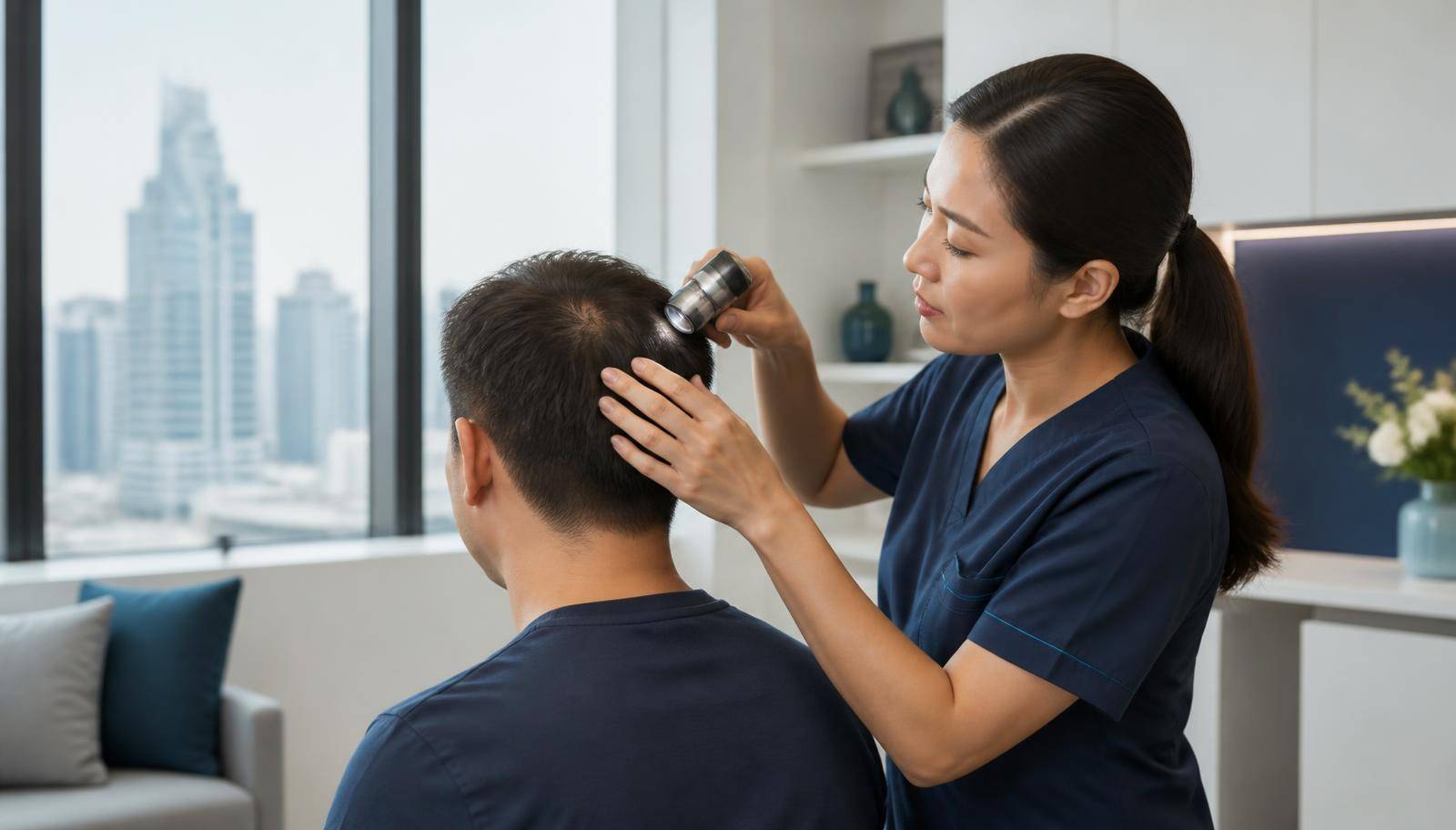
Most people notice hair loss in photographs or under bright overhead light before they notice it in the mirror. By that point a meaningful proportion of density has usually already been lost. This article explains what the pattern tells a clinician, what has to be excluded first, and where platelet-rich plasma honestly fits.
Thinning at the Crown or a Widening Parting: What It Signals
Pattern hair loss is gradual and follows a recognisable distribution: recession at the temples and thinning at the crown in men, a widening central parting with a preserved frontal hairline in women. The hairs themselves become progressively shorter and finer, a process called miniaturisation, rather than simply falling out in larger numbers.
- Scalp visible through the hair under direct overhead light
- A parting that has widened noticeably over one to two years
- A ponytail that feels thinner to hold than it used to
- Fine, short hairs replacing thicker ones in the same area
Sudden diffuse shedding over a few weeks, patchy circular bald areas, scalp scarring, redness or scaling are different problems entirely and need a dermatology assessment rather than a cosmetic procedure.
Causes of Hair Loss That Must Be Excluded First
Treating the scalp without checking the body underneath wastes both time and money. Several reversible causes are common and are found with straightforward blood tests.
- Iron deficiency, with ferritin frequently low well before anaemia appears
- Thyroid disease, both under and overactive
- Telogen effluvium following illness, surgery, childbirth or severe stress
- Vitamin D deficiency and significant protein or calorie restriction
- Medication effects, including certain retinoids and anticoagulants
- Autoimmune alopecia areata, which requires different treatment entirely
Nutritional and metabolic contributors are discussed further in our article on longevity and cellular health.
How PRP Hair Treatment in Bangkok Works
Platelets carry growth factors including platelet-derived growth factor, vascular endothelial growth factor and transforming growth factor beta. The rationale for scalp injection is that concentrating these locally improves the blood supply around the follicle and prolongs the growth phase of the hair cycle, slowing miniaturisation in follicles that are still alive.
Because it uses the patient's own blood, PRP has a favourable safety profile, with most adverse effects limited to injection-site discomfort, brief swelling or headache. The published evidence consists largely of small randomised studies and meta-analyses reporting increases in hair density, with variation between studies driven by differing preparation methods and session schedules. It is best described as supportive treatment with modest, maintenance-dependent results.
PRP Compared With Other Hair Loss Options
| Option | What it targets | Practical note |
|---|---|---|
| PRP injections | Follicular blood supply and growth phase | Autologous, needs maintenance sessions |
| Topical minoxidil | Prolongs growth phase | Daily application, effect stops when stopped |
| Oral antiandrogen therapy | Hormonal driver of pattern loss | Prescription only, requires medical review |
| Exosome scalp treatment | Signalling to the follicular environment | Newer, discussed separately in our exosome article |
| Hair transplant | Redistributes existing follicles | Surgical option for areas with no follicles left |
A detailed comparison of the cell-signalling approach is in our article on exosome therapy for hair loss, and the general treatment page is PRP therapy.
How the Treatment Is Delivered at Our Bangkok Facility
At MRC Healthcare the first visit is an assessment rather than a procedure. Scalp examination, a pull test, standardised photographs and blood tests for ferritin, thyroid function and vitamin D come before any injection is scheduled. Where a reversible cause is identified it is corrected, because a PRP course started on top of untreated iron deficiency is unlikely to show anything useful.
Blood is drawn and processed in a closed system, and the platelet preparation and injection pattern are recorded so sessions can be reproduced. Photographs are taken at the same distance and lighting each visit, which is the only reliable way to judge change. Related skin work is described under exosome skin rejuvenation.
Fitting a Course Around International Travel
PRP suits travellers reasonably well. Each session takes around an hour including preparation, there is no sedation and no downtime beyond avoiding vigorous exercise, swimming and hair products for the rest of the day. Visitors commonly schedule a session at the start of a trip and combine it with other treatments in the same stay.
The complication is that the induction phase spans several months. Options are to return for each session, to compress the schedule slightly under physician guidance, or to have the induction phase performed at home and use Bangkok visits for maintenance. Discuss this before the first session. Wider planning is covered in our Thailand medical travel checklist.
Have Your Hair Loss Pattern Assessed Properly
Our physicians will examine the scalp, check the blood tests that matter and tell you whether PRP is a sensible option or whether something else should be addressed first.
Schedule a Consultation